
 RAID: Shadow Legends
9.8 / 10
Play now
RAID: Shadow Legends
Play nowA turn-based collection role-playing game with several hundred champions. Free to play, with optional purchases.
- Our score
- 9.8
- Genre
- RPG · Hero collection
- Players
- 4.1M players
- Reviewed
- 11 Sep 2026
What you are actually playing
RAID is a turn-based collection RPG with an unusually deep bench. Fights are four champions against whatever is in front of them, resolved one turn at a time, with every skill on a cooldown you can count. Nothing happens quickly enough to need reflexes, which means nothing is ever lost to a slow connection or a bad moment. The whole game is a sequencing problem you are allowed to think about.
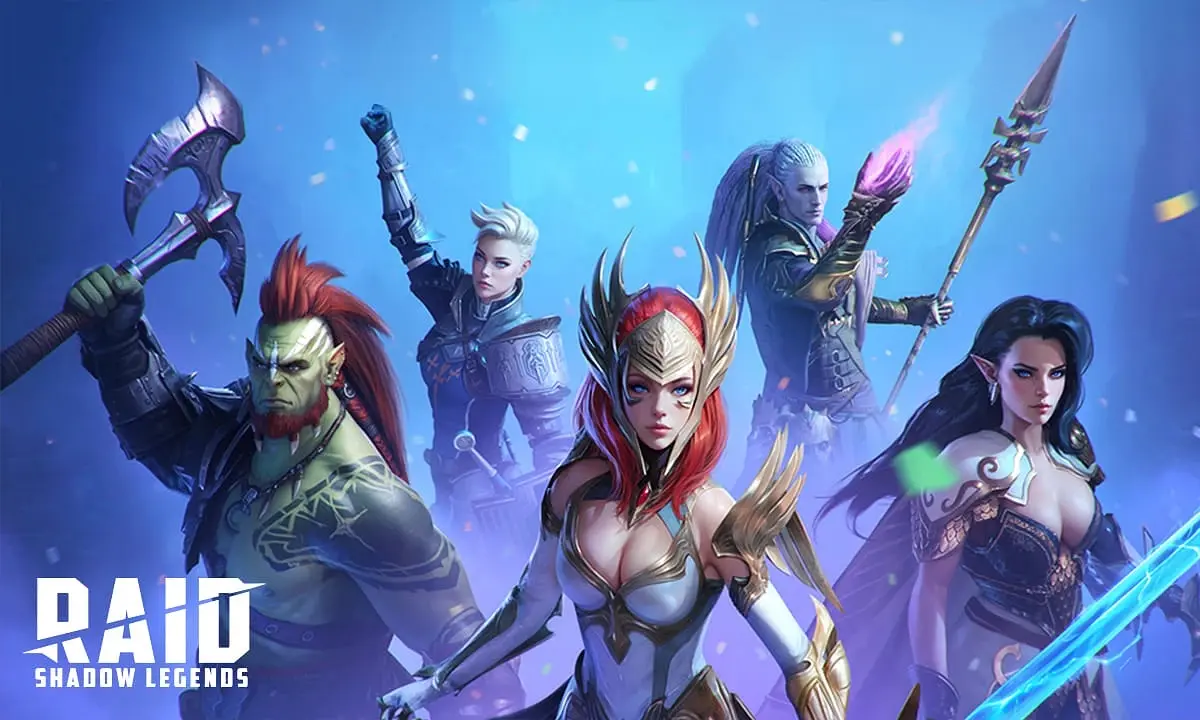
The roster is the product. There are hundreds of champions across several factions, and the difference between them is not a number but a job: one strips buffs, one blocks damage for the team, one refills turn meters so the rest act twice. Beating a wall usually means recognising which job you are missing rather than levelling the same four higher.
The first hour
The opening is generous and does not hide it. The campaign hands you a full team before it asks anything, the first shard openings are weighted so that nobody starts with nothing, and the early stages fall over quickly enough that you feel the account moving.
The hour ends where every game of this kind ends: at the first stage that does not fall over. What matters is that the answer is legible. Something in front of you is healing, or stunning, or hitting the whole team, and there is a champion in your vault whose entire purpose is to stop that. Working that out is the game.
How progression works
Three lines run at once. Champions gain levels by consuming other champions, which is why the campaign is farmed on repeat. They gain ranks by consuming better ones, which is slower and more painful. And they gain most of their real power from gear, which comes out of the dungeons rather than the story.
Masteries sit on top of that: a long skill tree per champion, paid for with a currency farmed in a mode of its own. It is the point where the game stops being casual, and it is also the point where a mid-tier champion becomes genuinely good. A free account reaches it comfortably; it just takes weeks rather than days.
The dungeons are the real progression once the campaign stalls: each one drops one kind of gear, each one has a mechanic that punishes a team built without thinking, and clearing a higher floor is worth more than any number of campaign runs. If you are stuck, the honest answer is almost always that your gear is from the wrong place.
Where the money appears
Energy, and the shards that hold the best champions. Energy is the softer one. It refills on its own and the campaign is not going anywhere. Shards are the sharp end: the odds on the rarest tier are low, they are sold in bundles, and the game is at its least charming during an event that wants you to open forty of them.
What keeps the score high is that the free path works. Login rewards, events and the campaign hand out enough shards that a patient account builds a competitive team, and the champions who solve the hard content are not all locked behind the paid tier. What money buys is the top of the arena and the time you would otherwise spend farming.
Playing with other people
The clan is where the account earns its best rewards. Clan bosses are fought by everyone at once against the same target, and the reward scales with what the clan collectively does, which means a clan that logs in is worth more than any single champion you own. There is no pressure to talk; there is a great deal of value in being somewhere that does.
How it runs
It is turn-based and it is not demanding, which is the point on an older machine: nothing is happening in real time, so a frame drop costs you nothing. Battles can be set to resolve automatically once you have won them by hand, and that is the difference between a game you play and a chore you perform. You fight the fight that is interesting and let the tenth repeat of it run itself.
What it does better than the rest
- Hundreds of champions, and the free ones carry further than they should.
- Turn based, so a slow connection never loses you a fight.
- Auto-battle clears the farming once you have won it by hand.
- Every wall has a legible answer, and it is usually a champion rather than a purchase.
Where it falls short
- The rarest tier is a lottery, and the game is loudest about it during events.
- Gear farming is genuinely repetitive, and no amount of automation hides that.
- The interface assumes you have been playing for a year, and the tutorial does not prepare you for the number of systems waiting behind it.
Your first week, in five moves
- Push the campaign until it stops, then stop pushing. The wall is a gear problem.
- Join an active clan on day one, for the boss rewards rather than the company.
- Do not rank up champions you will not keep. Feed the bench to the four you are using.
- Learn one dungeon properly before touching the other three.
- Save shards for the events that guarantee something, rather than opening them as they arrive.
Who it is for
People who like the puzzle of a team more than the drama of a fight, and who are content to solve something slowly. It is not for anyone who wants to see the whole roster quickly, and it is not for anyone who dislikes a lottery. The best champions arrive by chance, and no amount of patience changes the odds on a single opening.
The verdict
The deepest roster on this list and the most patient game on it. RAID asks for weeks rather than evenings, and it repays them, as long as you are the kind of player who enjoys being handed a locked door and a hundred keys to sort through.
Questions people ask
Is RAID free to play?
Yes. The campaign, the dungeons and the clan content are all open to a free account, and the champions that solve them are obtainable without paying. Money buys the arena and the speed.
How long before it gets hard?
A few hours. The first real wall is a gear wall rather than a level wall, which is why the answer is usually a dungeon rather than another campaign run.
Do I need to play every day?
No, but the daily and clan rewards are the steadiest income in the game, and ten minutes collects them. Nothing is lost by missing a day.
Is auto-battle cheating?
It is the intended way to repeat content you have already beaten. The game expects you to solve a fight once and then let it run.
What should a beginner spend on first?
Nothing, for the first week. After that, the value is in whatever removes farming time rather than in a single champion pull.